

What you need
- Funds on the chain where the token you want lives, plus gas. You will find out which chain in step 1.
- Time to read the issuer’s terms, including where the token is available.
Steps
1
Find every version of the token
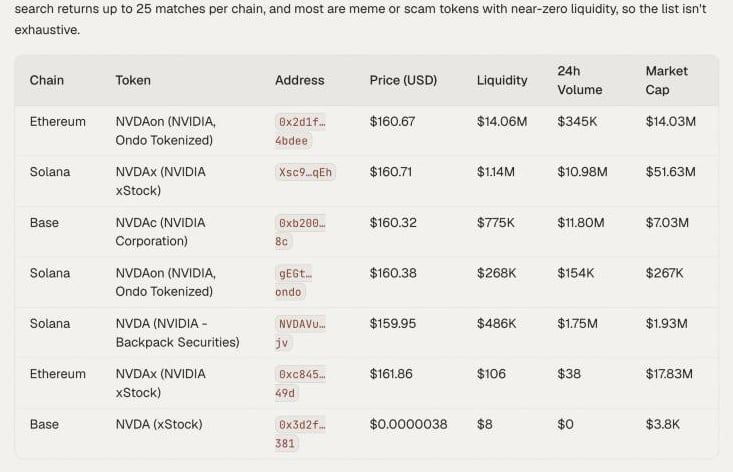
Tokenized versions of one stock across chains, with liquidity for each
2
Pick the one with real liquidity
Prefer the version with the deepest liquidity and steady volume. Compare its price with the stock’s own price; a large gap means the pool is thin or the price is stale. Open the chart link the agent gives you and confirm the contract.
3
Read the issuer's terms
Check what the token gives you, how dividends are handled, and whether it is offered where you live. OpenFinance shows you the token; the issuer sets its rules.
4
Fund that chain (moves money)
5
Get a quote
6
Swap (moves money)
Reply yes if the token address and amounts match. Onchain swaps cannot be reversed.
7
Check the holding
FX tokens
The flow is the same. Start with a search:Spot token or perp
If you are still choosing between holding a token and trading a perp, these are the main differences:Check it worked
- The token in your wallet has the contract address you chose in step 2.
- The value roughly tracks the stock or currency it follows.
Common mistakes
- Buying the thinnest version. A token with little liquidity can trade far from the stock price, and selling can cost more than buying.
- Assuming shareholder rights. Read the issuer’s terms.
- Funding the wrong chain. USDC on Base cannot pay for a swap on Solana until you bridge it.
- Checking one chain for holdings. Ask the agent to check every chain, including Robinhood Chain if you hold tokens there.
Next guides
Stock and FX perps on Hyperliquid
Leveraged exposure instead of a token.
Options
Options go through your own broker account in the app.